
Sometimes I love living in the future. We may not have bubble cars, space habitats or travel to work via jetpack, but we do have other exciting things like ultra high-res, GPS-ready portable computers, a globe-spanning internet and the slow-grinding gears of social progressivism. Hooray for the future!
We’ve also seen the rise of indie games, a development that may not be as epoch-defining but is certainly welcomed with great warmth. Indie games have always been around, of course, but over the last five years we’ve seen their popularity, sales and critical acclaim skyrocket upwards. What is often most exciting about indie games is the sense that their creators – usually composed of very small teams – are making the games they love, and have always wanted to play.
One such game is Space Pirates & Zombies.
SHIT GROWING ALL OVER THE WALLS
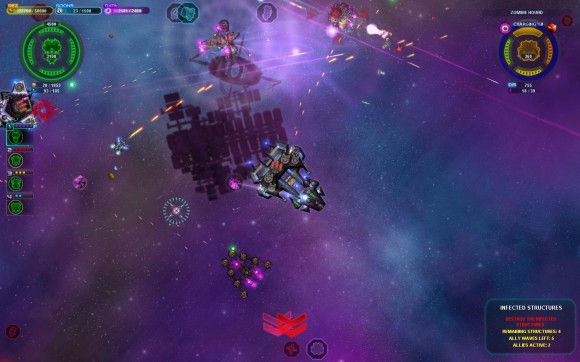
Space Pirates & Zombies is, by degrees, a top-down 2D shooter, a resource collection and management game, a tongue-in-cheek space opera, and a strategy game. If you’re anything like me, at this point you’re thinking, “hey, that sounds like Star Control!”
Actually, if you’re really like me, you’re thinking “hey, that sounds like Star Control 2 but with the base-building and colonisation elements from the ghastly Star Control 3!” But it’s probably for the best if you’re not that much like me.
The game starts you off gently, introducing you to your flagship, the Clockwork, and the small fleet you actually get control. You start off with a few simple mining tasks, soon moving on to actual missions and a spot of space combat. Within an hour or so you’ve upgraded your first ships to superior designs, made some friends and some enemies, and learned how the various levelling/advancement systems of the game work. In terms of how to do what you need to do, this is a pretty effective crash course.
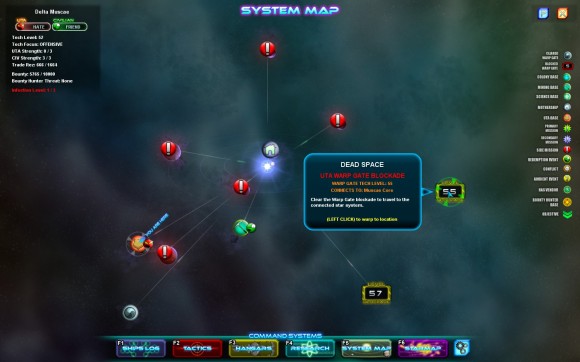
Soon enough, though, you’re smashing through a warp gate blockade and unleashed upon the galaxy at large. At this point the game really opens up, allowing you to choose where to go, who to fight, which techs to unlock and which general strategies to pursue. Your ultimate objective is to get to the heart of the galaxy.
WE DID IT ALL FOR DON
The game’s plot is entertaining enough, with a whiff of Al Reynolds-esque nihilism about it. The limited written dialogue (restricted to the game’s few plot missions) is clumsily written and with broad strokes, and the narration between chapters (provided by CynicalBrit.com’s TotalBiscuit) lacks impact, but this is a pretty minor complaint.
What developers MinMax do get brilliantly right is the tongue-in-cheek satirical tone of the game. To take one of the best examples, one of the game’s main resources are “goons” – your crew, essentially. They are eminently disposable saps and you can see them leaking out of larger vessels which are taking heavy damage, flailing desperately in the airless void before they go still. As you cruise around space you can pick up lifepods (from destroyed ships, usually) and attempt to recruit the goons inside to your crew. And if they decline?
“Hostages that complain go out the airlock with the rest of the trash.”
There’s a cute, silly little scream and one of those struggling figures is ejected at speed from your ship. It’s horrible, but it’s also in keeping with the game’s sentiment: life is very, very cheap in this galaxy. It’s a dark aesthetic touch that lends itself perfectly to the game’s mechanics (gather resources, destroy huge numbers of enemies) and is then bound up in narrative. No part of the game feels untrue to another part. Two men got that right. It doesn’t seem to even occur to some huge studios.
BEYOND THE BLACK HOLE
Things change up nicely over the game’s four chapters – or three, really, given that the first is an extended tutorial. Over the course of the second chapter you’ll explore the outer fringes of the galaxy and become steadily bigger and tougher. In the third chapter, you’ll encounter some new… friends. And in the fourth, the stakes are upped and the gameplay focus changes considerably.
I’m trying to avoid spoilers here. It might be better to focus on the mechanics: over the course of chapter two there’s plenty of opportunity to explore different types of module and ship and find out which tactics work best and which you prefer. You can then invest your time and energy in the relevant branches of the upgrade tree. The third chapter introduces a different set of challenges, and you may need to throw your existing rulebook out of the window – whilst still bearing in mind that your old enemies are still out there. Come the fourth chapter, you’ll need to apply everything you’ve learned so far in a new, more strategic context.
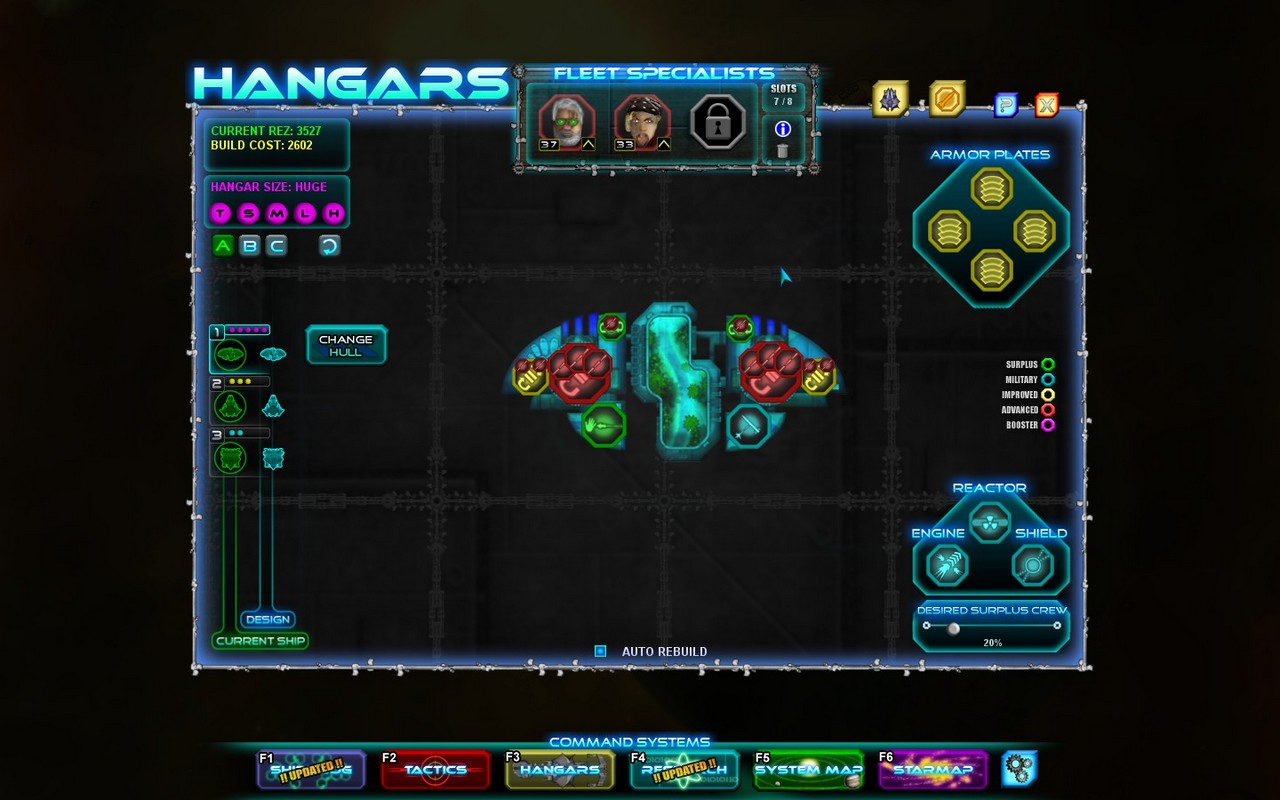
I’ll let you find out what those new challenges are on your own. It’s part of the fun. SPAZ gives you everything you need to be adaptive; it only takes a minute to entirely redesign a ship or your fleet, you can respec the tech tree (albeit with some ‘debt’) if you find yourself in a dead end, and even if you mess up and lose a lot of hard-earned resources it only takes a little while to build things back up – if you’ve encountered complaints elsewhere about having to grind to recoup losses, let me state that at least in the game’s present incarnation, those are over-stated.
That said, there are some difficulty spikes at the start of chapters three and four, and so I would recommend a bit of grind indulgence before you take the next step forwards. It’s always good to go somewhere new with a full hold of resources, a full complement of crew and a distinct tech advantage, eh?
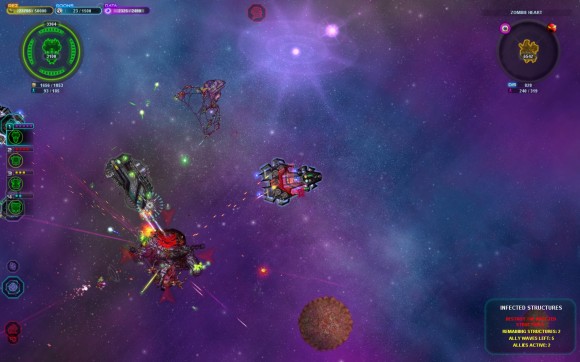
Fortunately the game’s core combat mechanics are a perpetual treat: you can switch between different ships within your small fleet on the fly, so if you get fed up trudging around in your gargantuan battleship you can fly something more agile for a while. Different opponents and scenarios demand different loadouts, so you’re not always wading in with the same armament and approach. And the game’s visuals are really, really lush, with the eye-catching ship designs and weapon effects simultaneously engrossing and clear.
There were points where I will admit to becoming a little bored – the aforementioned grinding moments, and towards the very end of the game where I was admittedly delaying the final confrontation through choice – but I invested forty well-spent hours in SPAZ. It’s a big game with no shortage of challenges, it’s been continuously updated since release (a little over a month ago an entire new faction was added for free), and it deserves to be played, whether or not you’re nostalgic for top-down space adventures.
Good work, MinMax games. Please keep making awesome space games until you get bored of them.
Comments
5 responses to “Space Pirates & Zombies: Review”
Wish this would get a release on consoles. There was that game that came out from the ex-bungie guys but that did not satiate my desire for space exploration and was too focused on funnelling the experience.
Gotta second that, this would play so well with console controls. Its a pity it probably won’t happen though.
I remember the dudes that made Dungeon Defenders were complaining about how hard it is to release patches for consoles, both time and money wise. Loads of games on steam get massive updates like this one did, for free. Terraria got one that more than doubled the size of the game.
True enough – these are all games that've had huge updates since release. SPAZ has given them away for free which is great – the addition of Bounty Hunters really shakes up the game. Perhaps when they're "done" they'll look at porting it – it's not like this is a game that is going to date rapidly.
Ok, fine. You made me pick it up again. Some of the changes since I last played it do ease the grind: it now seems to generate more missions, and the free goons at levelup help, too. The difficulty spikes at chapter breaks are murder, though. When you think you are ready, level up until you are over-prepared. Then level up some more.
I do admire the elegance of the core game and the way the game expands and escalates. Everybody, if this game sounds interesting, go buy it now. There is a demo, but since playing it will only make you buy the game, you can skip that step.
Oh hell yes. The first time I entered act three I was brutalised; fortunately you can still retreat and lick your wounds at that point. I tried to express this problem in the review in a balanced way, but I think I may have understated the issues with the beginning of act four.
Fortunately, I habitually save before progressing past any point where a game asks "ARE YOU REALLY, REALLY SURE ABOUT THIS? DON'T BE A HERO!"